
For more from The Playhouse Post, subscribe our weekly newsletter here.
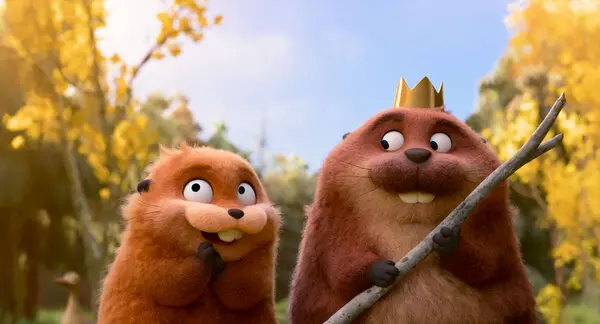
In the animated adventure Hoppers, a 19-year-old environmentalist named Mable (Piper Curda) figures out how to implant her body into a robotic beaver to save the endangered nature habitat near her home. While the concept is certainly sci-fi, beavers are anything but, and the animators at Pixar who brought Hoppers to life wanted to get that part of their work right. The team enlisted Dr. Emily Fairfax, a professor and beaver researcher at the University of Minnesota, to advise on the film. Dr. Fairfax provided Pixar with a fact sheet on beavers, provided exclusively to the Playhouse below.
Beavers 101: Fact Sheet
By Dr. Emily Fairfax
Beaver Biology
• Beavers are both a keystone species (other plants and animals depend on them) and an ecosystem engineer (they can reshape the physical earth)
• Beavers build dams, dig canals, and cut down trees.
• Most of the trees that beavers like to chew, such as willow, cottonwood, and aspen, can regrow from the cut stump and make clones from cut branches. This means beavers don’t kill all the trees they cut, and can actually help with “replanting” trees by dropping little cut branches everywhere.
• Beavers have been building dams for at least 7.5 million years. It may be as many as 25 million years.
• Beavers can weigh between 40 and 110lb as an adult. A typical adult beaver would weigh 60-80lb.
• Beavers are semiaquatic, meaning they live both in water and on land.
• Beaver teeth are orange because they have an iron-rich coating on the front size. Every time a beaver bites down the teeth self-sharpen.
• Beavers live in family units of 4-8 individuals. There is mom beaver and dad beaver that mate for life, their babies from that year (kits), and some “teenage beavers.”
• Beavers have babies once per year. Baby beavers stay home with their parents for 2-3 years before going out on their own to start their own family.
• Beavers live 10-15 years in the wild, but can live 20-25 years in captivity
• Adult beavers have only a few predators due to their size: bears, mountain lions, and wolves. Sometimes lucky coyotes. Baby beavers have many more predators, including eagles, owls, river otters, foxes, coyotes, and large fish
• Beavers only eat plants. Their favorite food is the bark from sugary trees like willow, aspen, and cottonwood. They also eat grasses, pond weeds, lilies, cattails, tubers, and fruit.
Beaver Populations
• Beavers are native to most of the Northern Hemisphere. They are native to: Austria, Belarus, Belgium, Bosnia, Bulgaria, Canada, China, Croatia, Czech Republic,Denmark, England, Estonia, Finland, France, Germany, Hungary, Italy, Iran, Iraq,
Kazakhstan, Latvia, Liechtenstein, Lithuania, Luxembourg, Mexico, Moldova, Mongolia, Netherlands, Norway, Poland, Portugal, Romania, Russia, Scotland, Serbia, Slovenia, Slovakia, Spain, Sweden, Switzerland, Syria, Türkiye, Ukraine, United States of America, and Wales
• Before the Fur Trade (pre-1700’s) there were 100-400 million beavers, which likely corresponds to about a billion beaver dams, in North America. The Fur Trade reduced their population to about 100,000 by the early 1800’s. Today there are 10-30 million beavers in North America, or about 10% of their historic numbers.
• Beavers were also hunted to near extinction in Europe and Asia, and by the 1900’s only around 2000 beavers remained. Today their population is about 1.5 million, which is a very small percent of their historic population.
• Beavers can live in almost any environment. This includes: forests, prairies, coasts, mountains, deserts, grasslands, and urban areas.
Beaver Benefits
• Beaver wetlands reduce the intensity of floods, protecting downstream infrastructure. They’re like speed bumps for the water and help slow it down and store it in the soil.
• Beaver wetlands are uniquely drought resistant. They can go many years without much precipitation and still be green and lush.
• Beaver wetlands are 3-times more fire resistant than rivers and streams without beavers. This makes them “fire refugia,” meaning they are a safe and protected place during wildfires.
• About 90% of beaver wetland area doesn’t burn during wildfire. It’s too wet to burn. In some cases, beaver wetlands can stop a fire and function as a true firebreak
• After a fire, beaver wetlands help the rest of the landscape recover. They are home to mature plants and animals that can help repopulate nearby burned areas.
• Beaver wetlands store 11-35 times more carbon than degraded / unhealthy river corridors.
• Beaver wetlands significantly boost biodiversity, including for pollinators like butterflies, bees, and bats.
• At one of my sites in California, we saw the number of species present increase 8- fold after beavers moved in.
• Beaver wetlands create habitat for threatened and endangered species.
• Beaver wetlands create habitat for culturally important hunting and fishing species, like ducks, trout, salmon, pheasants, and deer.
• Beaver wetlands help clean the water like a giant Brita filter. By slowing the water down and letting it flow through special microbial communities, they remove agricultural pollutants like nitrates and phosphates that are associated with algal blooms. They also remove heavy metals and bacteria like E. coli.
Beaver Management
• USDA Wildlife Services kills 20,000-25,000 beavers per year for conflicts that are real or perceived (meaning there doesn’t have to be an actual conflict, just fear of one).
• In some states, like Wisconsin, people can remove beaver dams on their neighbor’s property without a permit and they do not have to notify the landowner.
• In a few states, beaver dams are routinely removed with explosives. This destroys the dam and damages the surrounding ecosystem. Explosives are not allowed in many states due to the level of destruction and danger.
• In some states, beavers are being recognized as a partner in climate resilience.
• Where beavers are appreciated, we can solve conflicts with fencing, pipes, and education.
• In Eurasia, beavers are being intentionally reintroduced in many places to help restore biodiversity and protect communities from flooding.
• In the US, we briefly relocated beavers from conflict areas to the mountains via airplane and parachute in the 1940’s-1950’s. There is evidence of this in Idaho and California, but other states may have taken part too.
Hoppers is now playing in IMAX. For more on Pixar, check out this week’s newsletter.