
For more from The Playhouse Post, subscribe our weekly newsletter here.
Only two years after Star Wars, George Lucas set the stage for another pivotal Hollywood sensation.
In 1979, the restless innovator was searching for the future of special effects, and created a computer division at his company Lucasfilm to explore its potential. By 1986, however, that department became a costly burden for the company, especially as Lucas faced the economic setbacks of his passion project, Howard the Duck. In a desperate effort to liquidate assets, Lucas sold his graphics group to fellow entrepreneur Steve Jobs for $5 million.
By then, its staff had rebranded themselves with a name that would lead the revolution in 3D animation: Pixar.
Forty years later, the animation studio remains synonymous with the visionary storytelling that established it. There have been bumps along the way, the occasional overwrought sequel or half-baked idea, but the essence of Pixar remains intact: smart, soulful storytelling that elevates the potential of commercial animation.
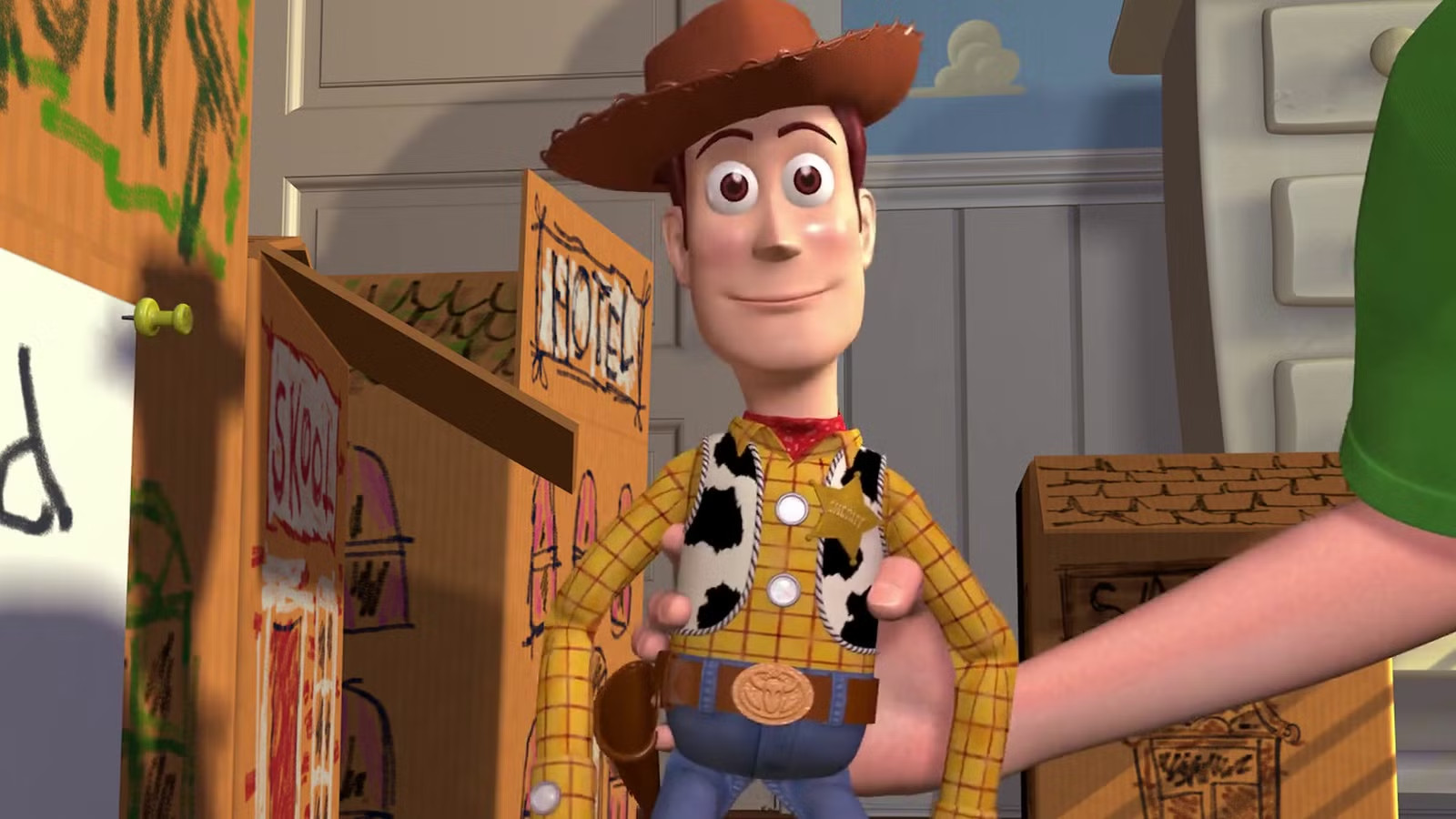
Starting with the blockbuster success of Toy Story in 1994, Pixar became the rare brand to merge compelling narratives with state-of-the-art technology. Not since Walt Disney himself had anyone so fully altered the expectations of the medium. By proving that a movie could be fully rendered with CGI, Pixar cast doubt on the future of handdrawn 2D animation, while making the essential case that no measure of computer wizardry could salvage a movie with a bad script.
As the studio’s ambition grew, so did its stable of writers, many of whom hailed from outside the animation business. By fusing adult-sized ideas into kid-shaped movies, Pixar expanded the appeal of the medium in two directions at once.
Hoppers, a playful sci-fi coming-of-age story that doubles as environmentalism, provides the latest indication that Pixar’s unique identity remains intact. As with Wall-E or Monsters, Inc., both of which envisioned a world starved of natural resources, this is an imaginative movie that funnels childlike energy into a meaningful statement about the fragility of the planet. The talking animals are cute and all, but they never outpace a genuine sense of purpose.
For its first act, Hoppers centers on Mabel (Piper Curda), a punk rock teen battling to stop a corrupt mayor from destroying the natural habitat near her house. The rest of the movie revolves around that as well, but complicates the scenario when Mabel comes across a groundbreaking experiment that implants her perspective in a robotic beaver, enabling her to communicate with the local animals and compel them to save their home.
This is vintage Pixar stuff. As with Up, which encapsulates the entire heartbreaking life of a couple in its opening minutes before evolving into a globe-trotting fantasy, Hoppers grounds the zaniest aspects of its stakes in real ones.
For decades, Pixar’s track record was coveted by the industry, and the process responsible for its success hasn’t changed much. Twenty years ago, Disney acquired the studio, subsuming its output into a much larger machine but leaving much of its essence intact. The Pixar staff remains cushioned within a tranquil campus in Emeryville, California, on the outskirts of San Francisco and far from the machinery of the Hollywood studio system.
Pixar’s strength comes from its collaborative philosophy. All staffers contribute to each project. Up and Monsters Inc. director Peter Docter serves as chief creative officer; the senior creative team working on most features have writing and directing credits on other projects. The hivemind behind Pixar presents a rarified opposition to the hype of the marketplace. Pixar operates within its own bubble of hype. Even its biggest franchises stem from homegrown ideas: Bring on Toy Story 5 this June.
The continuing success of Pixar raises a hypothetical question. What if Lucas had tabled his graphics division instead of selling it off? Surely other studios would have put forth their own CGI efforts, but it’s hard to imagine anything succeeding at the same level. If early 3D animation lacked the Pixar touch, there would have been little reason to believe in the future of the medium. Pixar established a standard for all technological progress. It always needs more than snazzy surfaces to succeed.
Hoppers is now playing in IMAX at the Southampton Playhouse.