
This article originally appeared in our weekly newsletter. Subscribe by signing up for a free loyalty account here.
Fifteen years after the first James Bond movie and a decade after The Sound of Music, Hollywood had entered a strange limbo. Costly musicals and romantic epics verged on extinction as a new generation of film school grads and hippy iconoclasts pushed American cinema into edgier spaces. Cultural sensations such as Easy Rider, The Godfather, and Dog Day Afternoon brought gritty personalities and darker themes to American screens, a trend that shifted only with the blockbuster arrival of Jaws in 1975 and, two years later, the first entry in a promising new franchise called Star Wars.
Rocky arrived in the midst of these seismic shifts. Produced on the fly for $1 million, this crowdpleaser about an underdog boxer who punches his way to champion status marked the first produced screenplay by its little-known star, Sylvester Stallone. The rest is history: Three Oscar wins, five sequels and three more spin-offs later, Rocky epitomizes the potential of grassroots artistry that worms its way into popular culture.
That’s the rousing tale at the center of the new biopic I Play Rocky, in which Anthony Ippolito (himself something of an unknown on the verge of stardom) plays Stallone with furious energy as a hustling dreamer who hovers on the precipice of failure, working odd jobs while demanding autonomy over his dream project and risking its implosion more than once. Directed by Peter Farrelly, I Play Rocky captures the thrills and gambles of the filmmaking process, though it helps to get so invested in a story when everyone knows the payoff to come.
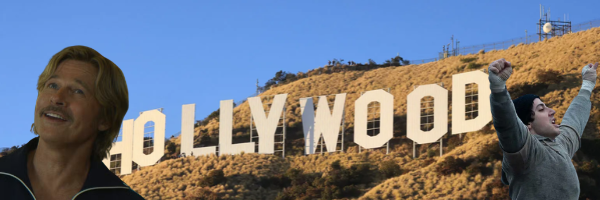
The Further Mis-Adventures of Cliff Booth depicts the flipside of that equation. Set a year after the events in I Play Rocky, this dark comedic sequel to Quentin Tarantino’s Once Upon a Time in Hollywood fixates on the lost souls who hover in the shadows of the industry’s bright lights. At its center is the same wayward protagonist of Tarantino’s previous film, an aging stuntman who navigates the underbelly of Los Angeles just as easily as he can take a punch. Only now, Cliff Booth is in the shadows more than ever.
David Fincher, who directs Tarantino’s screenplay with the playful ease of a shaggy-dog detective story, milks the atmospheric milieu at every turn. The Further Mis-Adventures of Cliff Booth unfolds over the course of several days in the summer of 1977, as the eponymous character divides his time between a projection booth gig at the New Beverly Cinema (which Tarantino now owns in real life) and odd jobs as a fixer for random Angelinos who need his help getting out of a jam.
Once Upon a Time in Hollywood took place in 1969, when movies still felt closely tethered to earlier eras. By the time of Rocky and Star Wars — nearly half a century ago — film culture existed in a state of perpetual transition. Patriotic WWII movies of the 1950s and 1960s thrived on television, glamorous movie stars turned grey, and the burgeoning porn business gave out-of-work actors some new outlets for their desperation. I Play Rocky and Cliff Booth both tap into this complex set of forces to mine compelling narratives.
I Play Rocky is an ideal companion piece for fans of the series, a reminder that one of the most iconic American movies of the past 50 years almost didn’t happen. Cliff Booth presents a different sort of pleasure: It’s a sophisticated ode to movies as a cheap pleasure steamrolled by commercial ambitions. As with his most recent directing efforts (Hollywood, Django Unchained, and Inglorious Basterds) Tarantino toys with history, building his own colorful universe based on real events. This world, thanks to Cliff Booth, never had to deal with the horrors of the Manson murders. But it faces other existential threats.
Tarantino voices these concerns wherever he can squeeze them in. Elizabeth Debicki, an ex-film critic-turned-talent agent who serves as Cliff’s newfound love interest, provides one vessel. As Karen Crosby, Debicki provides a glimpse of what Tarantino’s since-abandoned feature The Movie Critic might have been. An acolyte of The New Yorker critic Pauline Kael (they called themselves “Paulettes” at the time), Karen shrugs off Star Wars as “a technically superior version of Flash Gordon.” (Ouch. Expect further arguments to ensue when Star Wars gets reissued for its 50th anniversary in February.) Cliff, meanwhile, has a predilection for blaxploitation movies, much as Tarantino did in his youth. The movie argues against the canonization of film history. Taste is personal.
At times, Tarantino’s script echoes the sentiments of a Kael essay from 1969 aptly titled “Trash, Art, and the Movies,” in which Kael argues that the best cinema aims to please. Decades later, it’s still a controversial take. Here and there, Kael leaves room for a balanced view. “All art is entertainment,” she writes, “but not all entertainment is art.” Both I Play Rocky and The Further Mis-Adventures of Cliff Booth explore the valiant quest to have it both ways.
I Play Rocky is now showing at the Southampton Playhouse. The Further Mis-Adventures of Cliff Booth opens on IMAX next week.