
This article originally appeared in our weekly newsletter. Subscribe by signing up for a free loyalty account here.
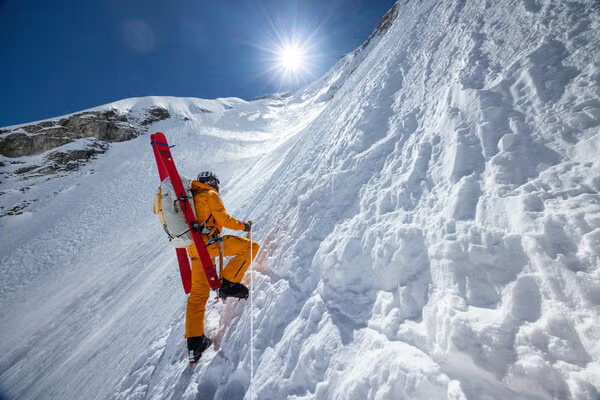
In the Oscar-winning documentary Free Solo, filmmakers Jimmy Chin and Elizabeth Chai Vaserhelyi capture the death-defying feats of rock climber Alex Honnold. With Everest: The Other Side, they turn their cameras on another shocking feat of physical endurance, tracking the efforts of ski mountaineers Jim Morrison and Hilaree Nelson as they set their sights on skiing down Mount Everest.
This feat, attempted by Morrison multiple times over the course of the movie, delivers a gripping spectacle on the IMAX screen — but it was even more harrowing for the team of collaborators tasked with bringing the movie to fruition. Morrison’s climactic effort to ski down the North Face of the mountain (something never accomplished before) imbues the movie with potent themes about the constant interplay of passion and endurance. Producer Anna Barnes was part of the dedicated team of adventurers who brought Everest: The Other Side together. I spoke to her by phone this week, and we were careful to avoid some of the biggest twists that the movie offers up.
ERIC KOHN: Since this movie is filled with surprises, how did the filmmaking team map out a narrative arc?
ANNA BARNES: We started making a film about Jim and Hilaree and this goal to ski down Everest. That never changed. Spoilers aside, we still hope people see the film as both of their stories. It was very important for us to tell this story of this woman we admired very much who was a mother, had a career, along with this life of risk and immense passion that she wrestled with every day. From start to finish, we never deviated from that.
Much of the drama revolves around whether Jim will successfully ski down Everest. What was the production strategy given that you didn’t know if he could pull it off?
It became very difficult because Jim tried three times to do this on Everest. We had to start cutting the movie and we didn’t know what the ending would be. For about a year, we cut the movie with a very happy ending of Jim completing the ski before we knew if we could do it. We had to have faith that everything would turn out OK in the end.
As a producer, what sort of challenges did this create in terms of keeping things moving along?
We had great partners at National Geographic who really gave us the time and space to finish what we needed to get done. It was originally supposed to be a three-year production and became a seven-year one. Every time we asked for an extension, they said OK. The anxiety was there every single day, even when we weren’t on the mountain. We didn’t know if we’d have the permits, if we’d have the money. We were constantly talking to the crew because everybody set aside like three months of their lives along with training time to be able to go to the mountain.
Walk me through what it’s like to shoot a movie in the freezing, high-elevation conditions of Everest.
We had a wide variety of cameras, including an ALEXA Mini LF for shooting at base camp. Of course, the low elevation there is like 5,000 feet. For the higher altitudes, it was a mix of drones for documenting the ski along with Canon R5c’s, which are great on mountains, very light and look great onscreen.
We tested all the cameras and lenses on IMAX screens long before we went to Everest to make sure we were using the best specs for that screen as well as framerate. The team had GoPros, which were essential. Our DP did several tests where we put the Canons in freezers overnight to simulate what conditions would be like for those cameras would be like under those temperatures. It hugely affects battery life. It was tough because we had to bring all our gear on yaks. We had to bring a lot of batteries because they drained very quickly.
At a certain point, we see the filmmakers themselves on camera wrestling with the decision to follow Jim up the mountain. When did that decision come up?
These were the conversations we were having amongst ourselves and we knew it was going to be very important as a way to tell that part of the story because we had those questions ourselves: What is the right thing to do in this situation? We decided it would be important to include that.
What was on your mind when you started the last climb we see in the movie?
The mantra was, “We are successful if everybody comes home safe.” The biggest anxiety was the weather. We got the weather forecast everyday from these amazing guys in Switzerland. We’d get this email with details about the wind and cold conditions. That was the one thing we couldn’t do anything about. We were at the mercy of the Earth. ‘
Was there anything worthwhile from the shoot that didn’t make it into the final cut?
The beautiful shots of the ski were the ones we had. We went three times and condensed it into two trips. The team did find Irvine’s boot [an Everest climber who vanished in 1924] on one of the expeditions. That was quite an experience, to have a major historical discovery. It was the 100-year-anniversary, but such a tangent to the story that had no place in the film we made.
Is there another movie to make about that? What a find!
Time will tell. It was wild. I wasn’t there, but I got a phone call from Jimmy about it. That was something. I had to track down his surviving relative, his great-niece, and we called her in the middle of the night to tell her. That was pretty dramatic.
This might be a little obvious, but why was it important to envision this movie in terms of its theatrical presentation?
I mean, it’s the biggest mountain in the world and it deserves to be seen on a big screen. That was always how we envisioned it. It’s Everest! But also, Free Solo had an IMAX release, which was really an extraordinary way to see the film. Most people will never see these parts of the world, particularly the Chinese side of Everest, which is very difficult to access and remote. There’s something really special about being able to see this extraordinary part of the world in a theater.
If someone watches this movie and decides they want to ski down Everest, what do you say?
I think you need 30 years of training and experience to be able to do it in the right way. Jimmy skied the south side in 2006. Jim spent 35 years thinking and reading about this, looking at the route, skiing all these other mountains, training, getting into the best physical condition. It’s really an accumulation of all that work and experience. So I would say this: Give yourself a few decades to prepare.
Would you do it?
I don’t ski. [laughs]
Everest: The Other Side is now playing at the Southampton Playhouse on IMAX.