
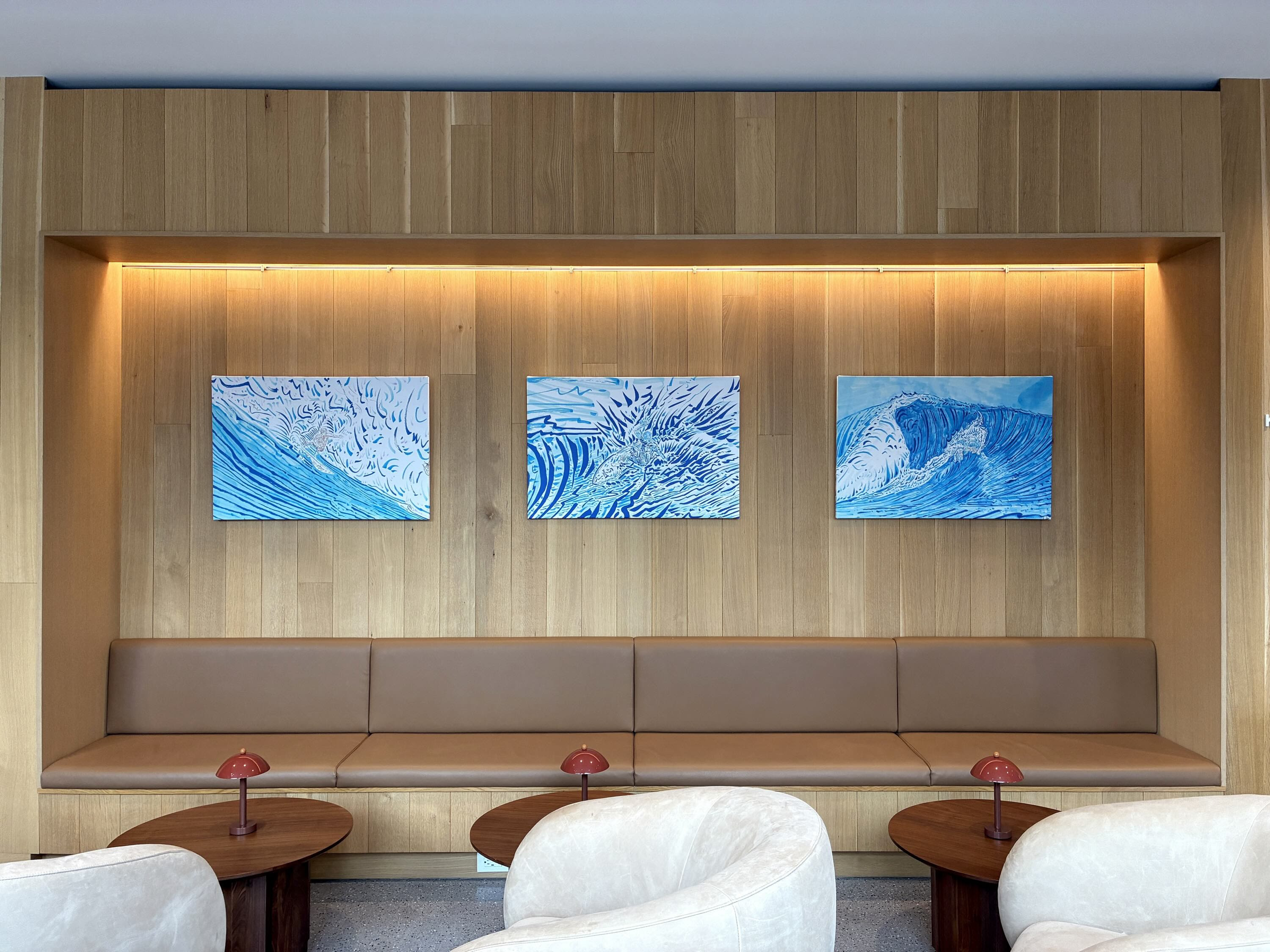
Chances are strong that if you’ve see a movie at the Southampton Playhouse, you’ve encountered Lutha Leahy-Miller’s handiwork. As the head projectionist, this lifelong Long Islander oversees screenings all week long from his perch on the second floor. Visitors to Leahy-Miller’s upstairs lair may also spot some of the colorful artwork lining the walls, some of which is currently on display in our lounge in anticipation of our Surfilmusic event. These paintings draw from his relationship to the region and the many waves he’s ridden over the years.
Below, learn more about Lutha’s multigenerational relationship to surfing and how it inspires his art.
ERIC KOHN: What came first for you? Painting or surfing?
LUTHA LEAHY-MILLER: I started bodysurfing and surfing with my dad as early as six months old, or so my parents tell me. My dad began surfing in the early ‘60s in Rockaway Beach, and then moved out here to Southampton in the very early ‘70s. So I was introduced to surfing at a very young age, but I really didn’t get deep into it until we moved to Kauai when I was nine years old.
I was also drawing from a very early age, and my parents’ friends were all artists, writers, and musicians. So I was exposed to so much art, film, music, and literature throughout the years, it was just natural to begin to draw and paint and so on. But I really began taking art seriously in middle school. My fifth grade art teacher, Mr. Whiteman, was so excellent. He was so good at teaching us techniques. So I pretty much decided I would be an artist for the rest of my life no matter what, which was also precisely when we moved back from Hawaii to Southampton.
I spent my senior year of high school as a Rotary exchange student in Mazatlan, Mexico. That year in Mexico I surfed nearly every day in Mazatlan, and I also spent about a month in Michoacán surfing at a bunch of the legendary Mainland Mexico surf locales. I spent two weeks in Michoacán with team Sinaloa, when we all drove down in a VW Bus for the Concurso Nacional De Surf Mexicana at Rio Nexpa. I was the first (and probably the last) gringo to surf in the Mexican Nationals. Our team won the contest!
I majored in fine arts at UC San Diego and minored in film and video. While attending UCSD, I was also invited to join the UCSD surf team multiple times by a few other UCSD surf team members, as well as Sean “Purple” Hayes, who was a very famous surfer at the time. Back then UCSD’s surf team was number one in the country, so it was quite an honor to be invited. I ended up not joining the surf team, because competition surfing wasn’t necessarily my favorite thing, but I am quite humbled to have been invited.
How long do you typically spend on these paintings? Tell us a bit about your process.
Most of them take three to four hours, sometimes a little less or a little more. I follow the tradition of many artists, who do five-minute, ten-minute, fifteen-minute, twenty-minute sketches, etc. So my thing is that I really enjoy being in the moment. I love the live feeling of making and creating art, one brushstroke at a time. So many of my works are sort of glorified ink sketches, with the imperfections left in. I simply make stuff I like, or would want to look at. And I’m just happy that other people also seem to enjoy it too.
Who are some of your favorite artists or other inspirations?
My favorite artists are Moebius, Magritte, Lichtenstein, Hokusai, Hiroshige, Rick Griffin, Robert Williams, and Herge. I also really like to play loud music. Each and every brush stroke is often timed to the rhythm music I’m listening to. Inspiration and surfing with the muses at high volume so to speak. I try to get into a sort of zen-like state when I’m making art, to think in images and motion instead of words or thoughts. The entire goal of my art is to be able to express the motion, feeling, and vibrance of the surf energy that is pulsing through the waters in my drawings.
What makes surfing on the East End of Long Island so different from other places?
A few things. First of all, our prevailing winds are offshore, out of the northwest.
Offshore winds at 5-15 kts are optimal, and groom the waves to clean and glassy perfection. When a low pressure front pushes through that brings us waves, or when a tropical storm or a hurricane is offshore, not only do we get good surf, but we also get offshore winds, which hold up and groom the waves wonderfully. A good analogy to decent surf with offshore winds is much akin to skiing or snowboarding on fresh powder as opposed to ice or fake snow etc. Onshore winds can turn good waves to utter shite in minutes.
It’s also not too crowded here — except at Ditch Plains, which is always crowded in the summer, where 50 or 100 people might be out in the surf. But generally, at most of the other surf spots, crowded would be more than 10-15 surfers out. In contrast, California surf spots can have up to 100-200 people out, a real shit-show!
The waves are more consistent here than elsewhere on the East Coast. Here on Long Island, we seem to have rideable longboard waves 2-4 days a week give or take, and rideable shortboard waves a few times a month on average. In late September, October, March, April, and early May however, we often get chest to head high plus shortboard surf around 6-8 times per month and sometimes more.
Long Island’s beaches face mostly southwest, south, or southeast, depending on where you’re surfing. The storms that travel west to east across the tri-state area often will track below Long Island, which gives us ground-swell pushing north towards our shores from the low pressure systems beneath us on the map. So that gives us a slight edge regarding waves and constancy.
What’s the best way for a novice to get into surfing out east?
The best way is probably one of the surf schools nowadays. In the old days, it “groms” — young surfers — would usually be taught how to surf by a family member or veteran surfer. My dad taught me how to surf, but a handful of top-ranked amateur and a few pro surfers also took me under their wings as my surfing developed. I adopted a handful of groms throughout the decades and passed on my knowledge to them as best I could.
After that, I taught my daughter Lila how to surf, beginning when she was around two years old. I used to put her in one of those life vests with the handle on it, and then paddle her out on the tip of my longboard to help her stand and surf with that handle on her life vest. She absolutely loved it right from the start, and she’s still surfing today whenever she comes home to visit.
Check out Lutha Leahy-Miller’s paintings in the lounge all week. Jack Johnson: Surfilmusic screens at the Playhouse on Thursday at 7PM, and will be followed by live music in the courtyard.