
This article originally appeared in our weekly newsletter. Subscribe by signing up for a free loyalty account here.
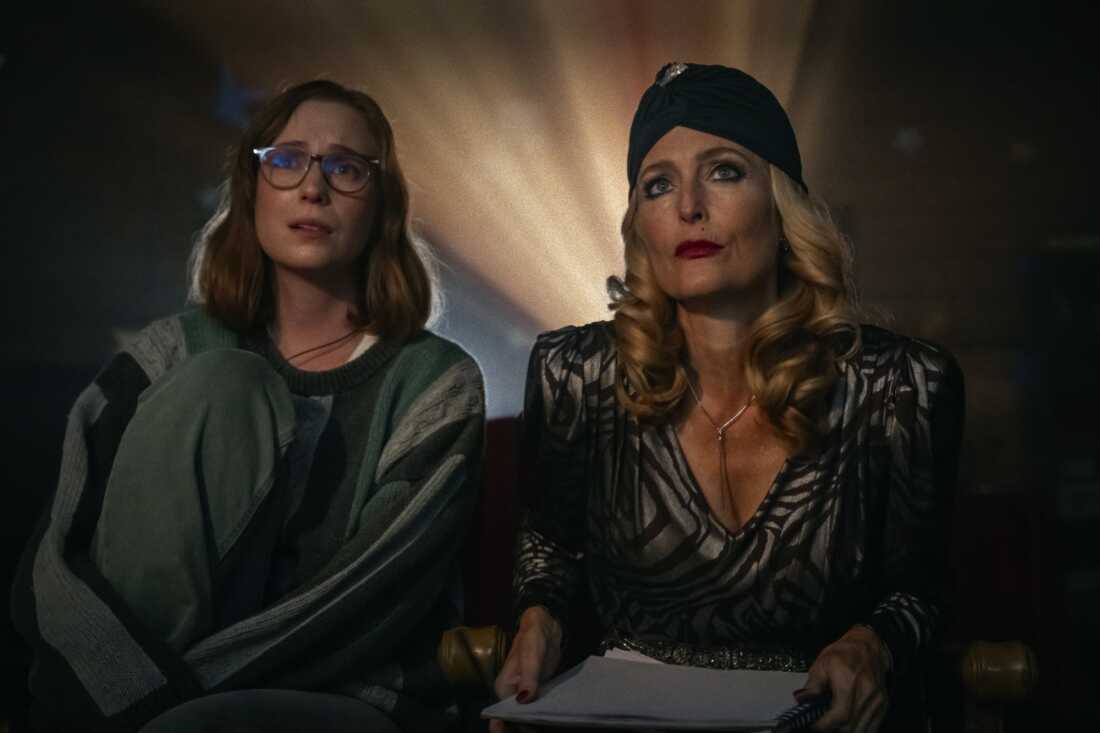
It’s hard to imagine another filmmaker more engaged with the current moment than Jane Schoenbrun. The filmmaker has engaged with questions of Internet lore, simulation theory, and sexual identity with their initial features We’re All Going to the World’s Fair and I Saw the TV Glow. Now comes Teenage Sex and Death at Camp Miasma, which adds depth and intrigue to Schoenbrun’s distinctive vision. The story of a young director (Hannah Einbinder) assigned to resurrect a long-dormant horror franchise, Camp Miasma finds her tracking down the series’ reclusive star (Gillian Anderson) and forming a strange bond with her. Sunset Blvd. by way of Friday the 13th, the movie is a unique snapshot of a major storyteller’s singular identity.
I spoke with Schoenbrun earlier this year ahead of the movie’s premiere at the Cannes Film Festival.
You started out your career working as a programmer for IFP, now known as the Gotham Film and Media Institute. How did that period influence your creative ambition?
Those years I spent at IFP were like film school. I got an early front row seat to early films by David Lowery, Shaka King, and so many others as they were figuring out how to build an auteur career in this landscape where there aren’t that many people under the age of 60. I’m really thankful that I got to learn how the industry worked and study it before it became time to make moves that would set me up to have the kind of art career that I want to have. I wanted to be there not as a bridesmaid but as a bride.
Your first feature, We’re All Going to the World’s Fair, premiered at Sundance in 2021. The movie was reportedly made for about $15,000. What was significant to you about starting off on such a small scale?
I understood when making World’s Fair that I needed to make that movie for basically nothing. I had to make something bold, and not like a normal Sundance movie. I’d just seen so many friends go through this process of making really cool short films and then getting their first feature “notes and agent-ed” to death. They were drained of any personality or originality. I understood that in America, in the commercial film system, I wanted any chance of doing something authored that was actually representative of the work I wanted to make, the first one had to be completely on my own.
In Teenage Sex and Death at Camp Miasma, a queer filmmaker takes on a new gig directing the latest entry in a slasher franchise. While not a traditional horror movie itself, the movie engages with specific horror tropes. What’s your personal relationship to the genre?
I’m sure there are filmmakers who are cynically sticking horror into their work because they know it’ll help the movie be commercial. I think there’s truth to that. I certainly am a beneficiary of the horror bump. I grew up obsessed with horror movies and it’s the language which comes most naturally to me in talking about the stuff I’ve been trying to talk about with these movies. With this movie specifically, which is very much about the lineage of the slasher movie – and also about sexuality and coming into one’s own body post-transition — if you read about the lineage of trans cinema, the slasher monster from Norman Bates in Psycho to Leatherface, it was never a doubt that the best way for me to talk about that process of remaking one’s own image needed to be done in the language of a slasher remake.
Your work plays with our ongoing relationship between reality and fantasy. Are we living in a simulation?
I really like Paul Preciado on this. He has a book about how dysphoria is not an individual condition or disease. It’s not something to be pathologized as this discrete population of people who have this individual issue. Dysphoria is a worldwide condition. As our world becomes more and more unreal, that unreality manifests a tension and sense of discomfort that we all feel. The glitch becomes the norm as we look around at a world that maybe 100 years ago made sense — at least to a certain class of people in America.
Now I think we have to create more and more of an effort to convince ourselves that there isn’t something deeply wrong and rotten at the core of it all. I have an individual application of that in my transness, which is one way in which the world around you doesn’t match the world that everyone is telling you to be in. That is a condition of society. As long as we continue pretending that we’re living in those boom years after WWII — as long as we’re clinging to power and economic structures that aren’t serving anyone and clearly destroying the world — we’re all going to be feeling more and more unreal.
Teenage Sex and Death at Camp Miasma screens at the Southampton Playhouse through Tuesday, September 1. There is a Q&A with the producer and cinematographer after the Saturday 9pm showtime. Tickets are available here.