
This article originally appeared in our weekly newsletter. Subscribe by signing up for a free loyalty account here.
“Human behavior remains a mystery to me.” So wrote Anthony Bourdain in the 2006 edition of his best-selling memoir Kitchen Confidential: Adventures in the Culinary Underbelly. Twenty years later, the former Brasserie Les Halles chef and globe-trotting TV host remains as much of an enigma as the places he explored. A foul-mouthed troublemaker and inquisitive storyteller, empathetic to the underprivileged and dismissive of dissenting points of view, Bourdain was a whirling dervish of contradictions, hellbent on scrutinizing the world and making it better but far less capable of doing the same for himself.
When Bourdain took his own life in 2018, it was the sort of jolting, tragic twist that threatened to overshadow a storied legacy. Yet nearly a decade down the line, Bourdain remains a treasured fixture on American bookshelves, with his hit series No Reservations and Parts Unknown still widely viewed on streaming services, and the snarky poetry of his baritone voiceovers no less familiar to foodies everywhere than they were in his prime.
The world isn’t finished with Anthony Bourdain. The years since his death have seen a slew of books about his legacy, from the dark dysfunction of his family life (Down and Out in Paradise: The Life of Anthony Bourdain) to the chaotic anecdotes from his former TV show entourage (In the Weeds: Around the World and Behind the Scenes With Anthony Bourdain). The 2021 documentary Roadrunner: A Film About Anthony Bourdain explores the way Bourdain’s friends and enemies in the culinary field were often the same people. Even the recent biopic Tony comes equipped with a new book, A24’s Happier, Stupider Times: Anthony Bourdain’s Provincetown Years, a period covered in Bourdain’s own autobiography in about 15 pages.
If the expanding field of Anthony Bourdain Studies sounds daunting, Tony provides an ideal starting point. Director Matt Johnson’s subtle and poignant character study hits the reboot on Bourdain’s ever-expanding mythology by focusing exclusively on the seminal moment he realized he wanted to be a chef. It’s not an attempt to grasp at the absolute truth; instead, Tony creates a quasi-fictional framework to unearth the reality of Bourdain’s ambition.
This Tony, played with exquisite brattiness and awkward determination by rising star Dominic Sessa, seems intent on self-destruction at any moment. Originally intent on becoming a great writer, he lies to his parents about admission to school and instead sneaks off to Provincetown to chase the girl of his dreams. “I was — to be frank — a spoiled, miserable, narcissistic, self-destructive and thoughtless young lout,” he wrote of this period in Kitchen Confidential, and Tony sets the stage by resurrecting this very quote.
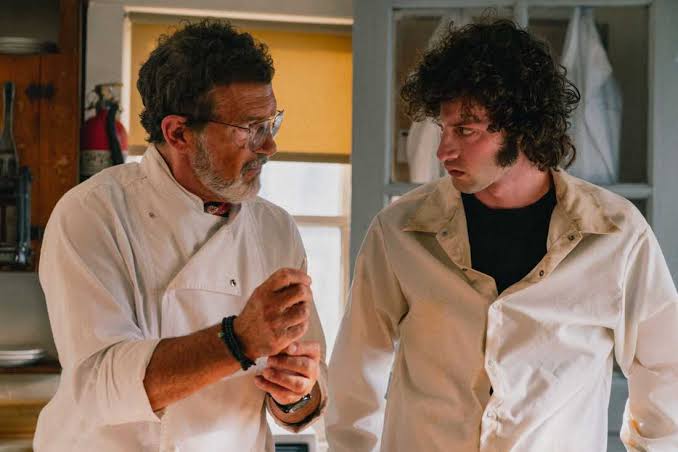
Tony condenses Bourdain’s journey into an anarchic summer of hard drinking, oyster shucking, and lots of hazing in the kitchen. It takes some liberties with the history, imagining a paternal mentor for Bourdain in the form of the head chef at a grimy seafood restaurant (Antonio Banderas), who lets the kid crash in a hammock when he has nowhere else to go. Young Tony makes awkward passes at his love interest (Emilia Jones) and takes notes on masculinity from kitchen alpha male Sal (Leo Woodall).
Above all, though, he watches everything around him with eagle-eyed precision, as if absorbing each detail for later regurgitation in his future literary masterpiece.
Sessa (whose talent first came to light with 2023’s The Holdovers) excels at conveying a nascent Bourdain — the sort of plucky, adventurous troublemaker who has yet to discover his voice. This is a terrific vessel for Johnson, a filmmaker whose previous work has shown his penchant for young men undone by reckless ambition (including his underrated debut The Dirties, about seemingly affable high school shooters, and Blackberry, a biopic about the naive founders of that ill-fated smartphone). Last year’s absurdist sci-fi comedy Nirvanna the Band the Show the Movie was a scrappy crowdpleaser made on a dime; Tony is a more polished work indicative of a director whose narrative skills have matured.
The masterstroke of Tony is that it doesn’t touch the sadness that followed: the heroin, the divorce, bridges burned, the shock of the suicide. Even the end credits only go so far as to hint at his future successes. There’s nothing hagiographic about this decision (after all, the Tony of Tony is hardly a saint). Instead, it’s a validation of the goodness inherent in Bourdain’s work, a passion for food as a means of connection that was unpretentious and universal. Nothing can change that.
In late May 2018, I interviewed Bourdain for IndieWire, where I worked as a critic and journalist for many years. After the publication of the story, which delved into his lifelong love of movies and they influence his show, he texted me an appreciative note. Eight days later, he was dead.
In the weeks that followed, I realized that nothing about these terrible developments negated the substance of Bourdain’s work. I didn’t know anything about the struggles Bourdain faced behind closed doors. In conversation, he was as thoughtful, incisive, and fun as his onscreen persona.
For years now, my wife and I have called up Bourdain episodes about various countries and states to learn more about them before visiting them ourselves. The program is timeless. “It’s always been, to one extent or another, a stealth food show,” Bourdain told me in our interview, and audiences are still benefiting from that brilliant coup.