
This article originally appeared in our weekly newsletter. Subscribe by signing up for a free loyalty account here.
Movies have delivered sweeping, epic storylines as long as they’ve been around. Early silent masterpieces like Intolerance and Metropolis embraced the dramatic scale of the big screen. Later decades brought David Lean’s sprawling achievements The Bridge Over the River Kwai and Lawrence of Arabia. George Lucas and Steven Spielberg ushered in the next generation of epics by transforming them into the modern-day blockbuster with the likes of Star Wars and Jaws.
Yet nowhere among this lineage lies a significant adaptation of the original epic, The Odyssey — until now.
Homer’s 2,700-year-old text finds an appropriate form in the hands of writer-director Christopher Nolan, who follows up his Oscar-winning Oppenheimer with a gripping and reverential version of the story. Many people know the fictional travails of Odysseus, after his successful sacking of Troy, when the king was adrift for decades while his wife Penelope kept various suitors at bay. Nolan doesn’t alter the fundamentals of that formula, but he manages to energize the material with new ideas while delivering a spectacular entertainment unique to the theatrical experience.
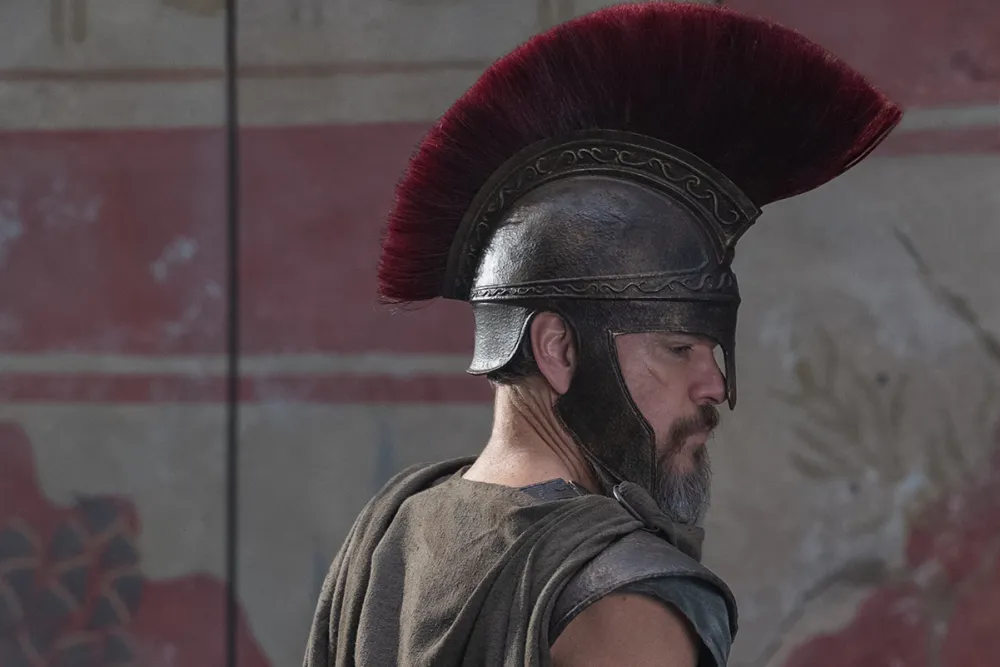
Nolan’s The Odyssey works well enough in its most immediate terms: as a riveting high-seas adventure in ancient Greece. Matt Damon’s stone-faced Odysseus endures cyclops, giants, sirens, and so much more in his quest to return to Penelope (Anne Hathaway), while his wimpy son Telemachus (Tom Holland) expresses regular concern. Nolan blends ambitious practical effects with every costly resource at his disposal to deliver an episodic survival yarn on par with its source. Fans of the poem will find much to appreciate, but newcomers can enjoy it at the same level, which attest to both Nolan’s skill and the timeless resonance of Homer’s own storytelling prowess.
Still, it doesn’t hurt to have some background on the precise factors that make The Odyssey such a significant Hollywood undertaking, the undeniable commercial and artistic behemoth of the year to date. Here’s a quick cheat sheet for those who could use a little guidance before diving in.
IMAX Makes All the Difference. The Odyssey is the first movie to be shot exclusively with IMAX cameras, as virtually every advertisement will remind. That’s not just marketing hype. It has a substantial effect on what you see on the screen.
In recent years, IMAX cameras have gained ground among filmmakers keen on using the large-format 70mm stock to make movies intended for the biggest screens. While IMAX theaters were originally known for hosting nature and science documentaries at museums, the company began to adapt to the wider market around the time of James Cameron’s first Avatar movie in 2009.
One year earlier, though, Nolan made crucial inroads with the effort to shoot movies on an IMAX camera, capturing the opening bank robbery scene in The Dark Knight with the hulking devices. In ensuing years, several movies have followed suit, most notably last year’s Sinners, which utilized IMAX cameras during its memorable “psychedelic” dance sequence.
IMAX film strips are big, wide, and tall. Each frame features the expansive 1.43:1 aspect ratio, a huge contrast to the traditional 1.85:1 ratio on most feature films. The cameras are not the most practical tools on-set: They’re loud, large, and expensive, with every minute of film costing around $600 (and The Odyssey clocks in at just under three hours). But for filmmakers like Nolan, it’s well worth the effort, as the larger ratio fills every corner of an IMAX screen. The eye can sweep across the frame to explore the details of a vast world. The result is a unique kind of alchemy between the screen and the viewer, as audiences can literally get lost in the visual details. Make the most of The Odyssey by letting your eye wander the images from top to bottom. Three hours will fly right by.
The Language is Only a Little Modern. The Odyssey has been translated many times since it first surfaced in book form sometime around the 15th century, but the fundamentals have remained intact. Many English-language translations tend to regard Ancient Greek as if it were frozen in antiquity, destined to be read in stale variations of English that supposedly replicates the original style.
Emily Wilson’s gripping 2017 translation, which Nolan used as a key source, rejects that tendency in favor of a sleek, gripping style. Rather than opening by asking an unseen audience to “Sing in me, muse,” it gets to the core of Odysseus’ troubled existence: “Tell me about a complicated man,” opens Wilson’s version. Nolan’s The Odyssey gives its first line rapper Travis Scott, who delivers the opening stanza to a roomful of suitors in one of several nods to the contemporary audience. After all, what are rappers if not modern-day bards?
The Odyssey takes its cues from Wilson’s willingness to adopt some modern language without rejecting the milieu as a whole. Holland’s Telemachus calls Odyssey “dad” on more than one occasion. When asked about this supposedly radical twist at a recent press event, Holland didn’t hesitate. “I wouldn’t have even said ‘father’ back in the day, would I?” he said. “It would’ve been Greek.”
Exactly. The Odyssey doesn’t pander to its modern-day audiences, but Nolan recognizes the futility of trying to recreate an ancient feel in a fictional context. The Odyssey is not a period piece in the traditional sense. It’s a fantasy that was passed down through generations via oral tradition and performance. There’s no reason why modern-day performers can’t give it a few tweaks of their own. Speaking of which…
The Women Are More Empowered. The Odyssey is primarily Homer’s journey and much of the survivor’s story unfolds from his perspective. Much like Wilson’s translation, Nolan gives more room to define its female characters in an undeniably male-dominated tale. In an early flashback, Odysseus demands that Penelope take a new wife if he doesn’t return from war, and she replies that his memory wouldn’t dictate her decisions.
Later, as Telemachus speaks to his mother about the various men attempting to take charge of their kingdom, Penelope calls out the patriarchal assumptions in play. “I’ve been sitting on an empty throne for 20 years,” she says.
The Odyssey doesn’t upend the material to transform it into a predominantly feminist take. The drama still belongs to Odysseus. But the movie puts him, and the testosterone-fueled warriors he commands, in their appropriate place.
Another crucial adjustment arrives later in the story, when Homer encounters the witchy Circe (an excellent Samantha Morton), who transforms his men into swine. In the original text, no explanation is given for this decision. Nolan’s The Odyssey clarifies that.
The sorcerer herself only receives a handful of scenes, though Nolan’s depiction mirrors the depth of the character explored in Madeline Miller’s 2018 novel Circe. As Odysseus struggles to convince Circle to transform his men back to human form, Circe only does so by telling them to return to their “disguises.” Thousands of years after its original composition, The Odyssey finally acknowledges that men are pigs.
The Gods are in the Background. Greek mythology figures heavily in The Odyssey, with Gods regularly communing among humans and making crucial decisions that affect their experiences. Odysseus’ plight regularly turns on decisions by various Gods to help him out or complicate his journey. While Nolan’s The Odyssey doesn’t negate their present, it avoids any sort of supernatural overstatement, relying instead on a more intense, naturalistic approach. The Gods are in the background.
There’s no Zeus hurtling thunder or furious Poseidon tossing waves, but these forces make themselves present throughout. Odysseus has conversations with goddess Athena (Zendaya) throughout, but she lurks in his conscience for reasons that remain unexplained until a clever twist in the final moments.
Then there’s Calypso, the divine nymph who takes Odysseus as his sex slave and deprives him of his memory for seven long years. The poem describes Calypso as a woman of divine, otherworldly beauty. Nolan gives us Charlize Theron, who doesn’t need any supernatural adjustments to convey that impression.
While monsters abound in The Odyssey, none loom larger than Polyphemus, the cyclops who devours scores of Homer’s men. Polyphemus is the son of Poseidon, the lord of the ocean, but Nolan doesn’t linger much on this detail.
His monster hails from the earliest days of stop-motion special effects pioneered by the great Ray Harryhausen in Jason and the Argonauts and Clash of the Titans. Nolan built a 60-foot tall creation for his hideous monstrosity rather than relying on CGI. Even when The Odyssey demands a larger-than-life spectacle, Nolan has found a way to ground it in real life.
Christopher Nolan’s Usual Obsessions Drive Everything. Throughout his nearly 30-year career, Nolan has maintained a consistent obsession with the same themes. Men are haunted by decisions that fling them across sprawling worlds, from the wormholes of Internstellar to the dreamscapes of Inception and the shadows of the batcave. His 1998 debut Following, about an obsessive man who trails strangers around the city, hints at the same soul-searching journey faced by Odysseus.
The Odyssey exists in the shadow of war, as the clever trickery of the Trojan Horse becomes a paradoxical source of guilt for Odysseus. In that regard, it operates as a kind of prequel to Oppenheimer, as both fixate on humanity’s inevitable draw to conflict and self-destruction.
Nolan’s movies are time-shifting puzzle pieces. His 2000 breakthrough Memento tells its entire story in reverse. The original Odyssey text jumps around, too, opening the aftermath of the Trojan War and flashing back on multiple occasions to capture snippets of Odysseus’ travels. In Nolan’s version, Odysseus struggles with amnesia while in Calypso’s care, and assembles his memories in piecemeal.
It’s a perfect match of storyteller and subject. Nolan’s non-linear approach in all his work suggests that time isn’t a static force in characters’ lives. Everyone struggles to make sense of the past and its impact on the present. The Odyssey acknowledged that millenia ago, and now, Nolan has given his original influence the credit it deserves. His extraordinary achievement, the blockbuster of the summer, is the ultimate hat tip.
The Odyssey is now playing on IMAX.