
Subscribe to our weekly newsletter by signing up for a free account here.
A few days into the 2026 Sundance Film Festival, one of the more remarkable events was happening up the hill from the movie theaters, in the warm confines of a ski condo.
It was there, the day after the world premiere of the new documentary The Disciple, that a representative of the cryptocurrency art collective PlsrDAO played a few sample tracks from the Wu Tang Clan album Once Upon a Time in Shaolin. While certainly not the first time Wu Tang beats blasted from a crowded condo in Park City, this particular album only exists as a single copy – making the listening party into something of a historic event.
In The Disciple, Oscar-winning documentarian Joana Natasegara chronicles the strange saga of Shaolin, the brainchild of Wu Tang producer Cilvaringz. Conceived as a Renessiance-inspired attempt at creating rarified value around the ubiquity of contemporary music, Shaolin existed as a single copy sold to the highest bidder; it ultimately fell into the hands of beleaguered investor Martin Shkreli for around $2 million in 2015. After Shkreli went to prison for securities fraud, the FBI auctioned off his assets, and Shaolin found a more accommodating home.
The intrigue of the movie revolves around the backlash to the album, the idea that any kind of art can belong to only a privileged group. But the event provided something of a rejoinder to that frustration. At a time when virtually everyone feels empowered to access all information through the digital tools at their disposal, here was a cultural experience that could only exist in an isolated moment of time.

Throughout the room, artists were taking it in. Moonlight director Barry Jenkins sat in a corner scribbling into a notebook. I spotted other Sundance-anointed directors, programmers, and other industry stalwarts entranced by the rhythms, eyes closed. The few minutes we heard showcased a unique synergy between audience and art, the kind of thing that creative people crave no matter how much else can be conjured on demand. It was a good reminder for the community in the room that the Sundance hustle – a whirlwind of 24/7 networking often at the expense of the movies themselves – serves a higher purpose.
For the record, I appreciated what I heard of Shaolin, though I’d need a few more listens to grasp the full scope of its strengths. Aside from a few self-referential spoken word sequences about the nature of the project, the tracks that really stood out were melodious compositions brimming with the angry energy of Wu Tang at its best. When they finished, I was left thinking about the questions of rarification that hovers around art circles in general these days.
Clearly, that theme has been percolating with a lot of storytellers. The art world sits at the center of several high-profile Sundance 2026 entries. I had a blast with I Want Your Sex, a typically transgressive satire from filmmaker Gregg Araki, one of the pioneers at the center of the New Queer Cinema wave that emerged out of Sundance in the nineties.
The movie stars Olivia Wilde as a sadistic artist who exploits her powerful role to craft sexually explicit artwork of dubious value. In the process, she develops an unsettling S&M romance with her timid assistant (Cooper Hoffman, in a marvelously cringe-inducing turn post-Licorice Pizza). Araki’s hilarious script plays with the idea that most successful creativity involves some measure of con artistry. Notably, I Want Your Sex would almost certainly make a nice thematic double bill with another big Sundance premiere, The Gallerist, in which Natalie Portman stars as a woman trying to pass off a dead body as artwork at Art Basel.

Beyond these more explicit treatments of the subject matter, one can find distinctive explorations of rarification throughout the Sundance lineup. One of the bigger sales titles of the festival is Wicker, a lush and eccentric storybook romance about a middle-aged woman (Olivia Colman) who develops a romance from a magical man (Alexander Skarsgaard) made of pliable plant materials by a wizardly Peter Dinklage. The Wicker man lives to serve his partner, inspiring envy and resentment from across the small village community where they live. Everyone wants a piece of him, but only one can have him – the same mentality that gave rise to the Shaolin controversy.
Of course, nothing is more rarified than life itself. Thank god for documentarian Sam Green, who follows up his masterful 32 Sounds with The Oldest Person in the World, a charming and soulful look at supercentenarians. Green’s movie oscillates between interviews with many of the oldest people in the world and personal reflections about the confrontations with mortality in his own life, which includes a cancer diagnosis, family tragedy, and the birth of his young child. It’s a sensational portrait of what it means to keep living in the moment, regardless of what the future might provide, and something of a repudiation to more superficial pursuits.
The greatest rejoinder to materialism, however, falls to John Wilson. The filmmaker behind HBO’s cult hit How to With John Wilson has made a delectable essay film about his quest to understand the role of concrete in modern society. It’s about many other things, too – success, self-preservation, the emptiness of the entertainment business – but Wilson’s main focus is the way that the metaphor of concrete embodies civilization’s desire for permanence at all costs. His closing shot of a tombstone reminds us that humanity has insisted on this rocky bondage to the very end.

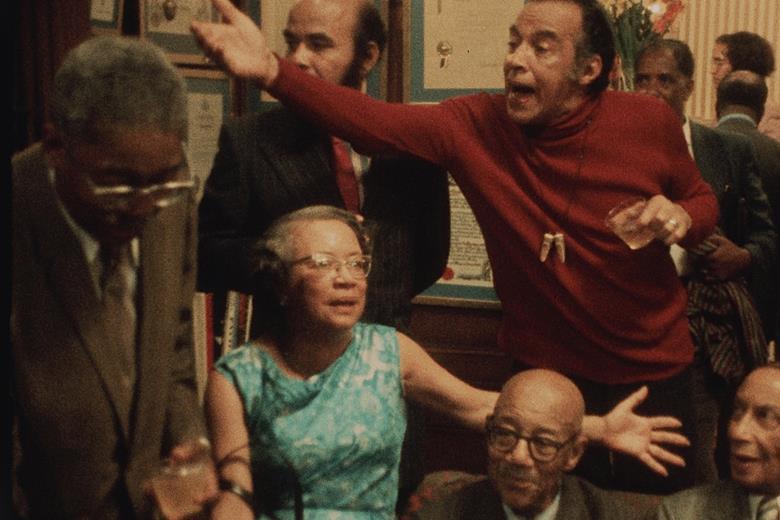
Death may be permanent, but movies resurrect the past like nothing else. That’s the essential victory of Once Upon a Time in Harlem, the indisputable masterpiece of Sundance in its first weekend. In 1972, filmmaker William Greaves gathered many of the living luminaries of the Harlem Renaissance for a boozy hangout session at Duke Ellington’s apartment, where they hosted an extensive salon on the legacy of the era that catalyzed an explosion of Black art and culture in America.
Greaves never finished putting the footage together before his death in 2014, but his son David has now completed the movie, and the world is much better for it. Greaves’ intimate camera brings us into the room alongside the likes of photographer James Van Der Zee, painter Aaron Douglas, and Ida Mae Cullen, the loquacious widow of poet Countee Cullen, who frequently interjects to make sure her husband’s contributions remain central to the conversation.
The exclusive nature of this gathering erupts from the past like a revelation. Those familiar with the Metropolitan Museum of Art’s 2024 show “Harlem Renaissance and Transatlantic Modernism” will find an ideal companion piece in Greaves’ restless camera, which captures debates about the nature of Black art amidst national oppression and whether newer generations understand its significance today. It’s a debate that spills off the screen and speaks to the current moment with shocking immediacy. Expect this one to make a lot of noise in the year ahead, as more and more audiences find their way into this incredible room. Talk about a rare opportunity.
This edition of Sundance has itself maintained a rarified feel. After 40-odd years, the nexus of independent film activity at the start of the year will move to Boulder, Colorado next year. For diehard Sundance veterans, each screening and party has the aura of one last hurrah. “It was great to have this different voice and be embraced here,” Araki said at one screening of his movie. “I feel like a lot of cinema is so much of the same old shit, and it’s very important for young filmmakers to do something different.” Wherever ephemeral art the future brings, here’s hoping that plea remains permanent.
Subscribe to our weekly podcast, Movie People, here.